When the Login Page Is Real: Device Code Phishing and the New Social Engineering Playbook
Learn how device code phishing uses real Microsoft login pages to steal OAuth tokens, bypass MFA, and exploit employee trust.
Summary
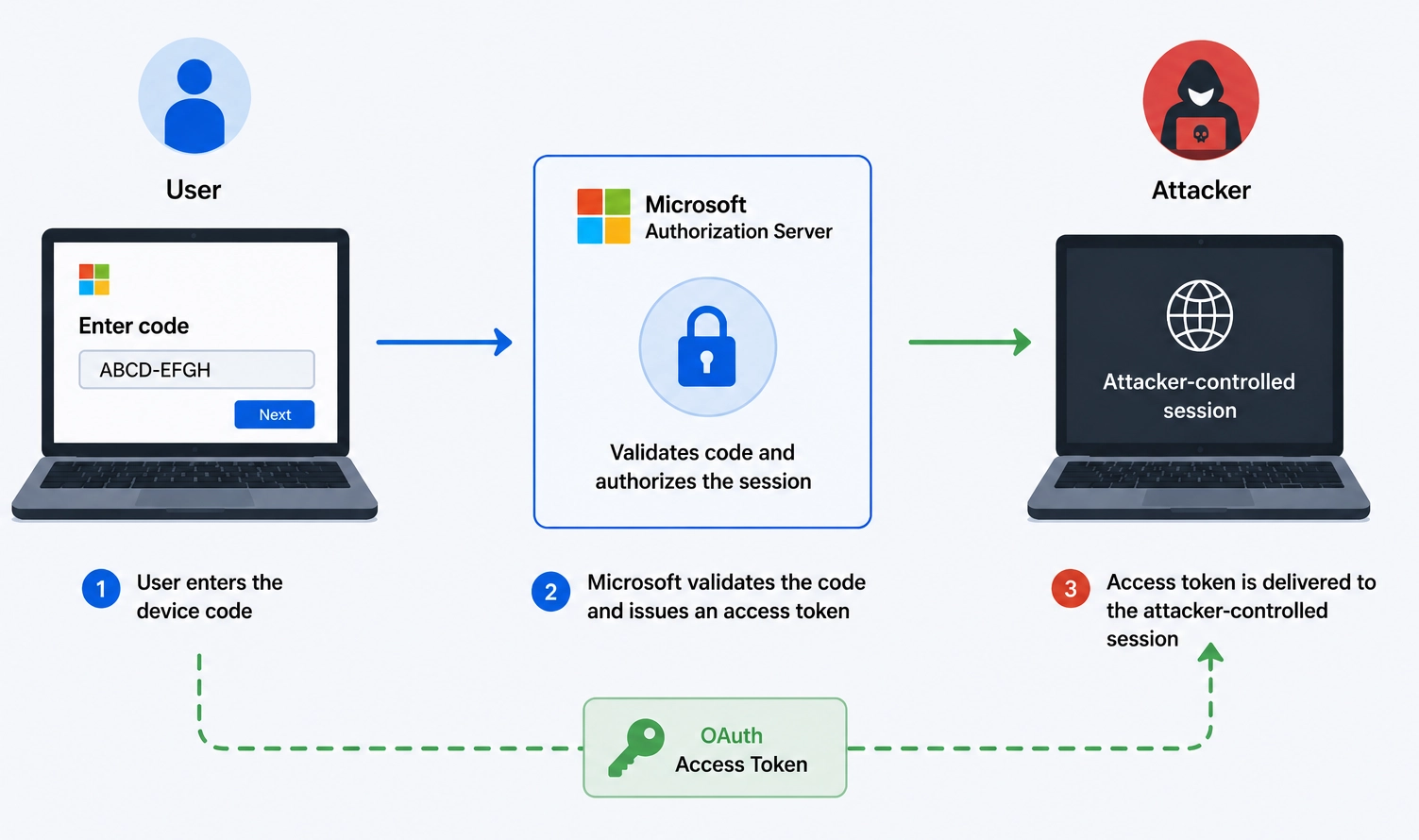
Device code phishing has moved from a niche red-team and espionage tactic into a mainstream account-takeover technique. Instead of stealing passwords through a fake login page, attackers abuse Microsoft’s legitimate OAuth 2.0 device authorization flow so a victim authenticates an attacker-controlled session on a real Microsoft page.
The FBI’s May 2026 advisory on Kali365 shows this capability is now being packaged as phishing-as-a-service, complete with AI-generated lures, templates, dashboards, and token-capture workflows for less-technical criminals. Microsoft’s April 2026 research also shows rapid growth, with dynamic code generation, brand impersonation, cloud-hosted infrastructure, and post-compromise email abuse appearing at scale.
For defenders, the key point is not just that device code phishing bypasses familiar training cues. It changes where the social-engineering decision happens. In classic credential phishing, users are tricked into entering credentials on a fake page. In device code phishing, the final page may be a genuine Microsoft login or authorization prompt. That makes advice like “check the URL” or “look for bad grammar” much less effective.
The better question is:
“Why am I being asked to enter this code, and who initiated this sign-in?”
Background
Microsoft’s device authorization grant exists for legitimate use cases. It is designed for input-constrained devices such as smart TVs, printers, kiosks, and similar systems. In this flow, the device requests authorization, the user visits a browser on another device, enters a short code, and the original device receives access and refresh tokens after sign-in succeeds.
Attackers exploit that convenience. Microsoft’s Conditional Access guidance now treats device code flow as a high-risk authentication method that can be used in phishing attacks or to access corporate resources from unmanaged devices. Microsoft recommends blocking device code flow wherever possible, which signals that the platform owner now views the flow as something that should be tightly constrained.
MITRE ATT&CK helps explain why the technique is attractive. Its Spearphishing Link guidance notes that malicious links can target device-based authorization flows, including OAuth 2.0 device authorization. Its Steal Application Access Token technique explains how OAuth tokens can provide long-term access to user data without obtaining the user’s password.
In practice, device code phishing lets attackers inherit a victim’s cloud identity and operate inside SaaS platforms with valid tokens, valid sessions, and less noisy behavior than malware-heavy initial access.
Attack Mechanics
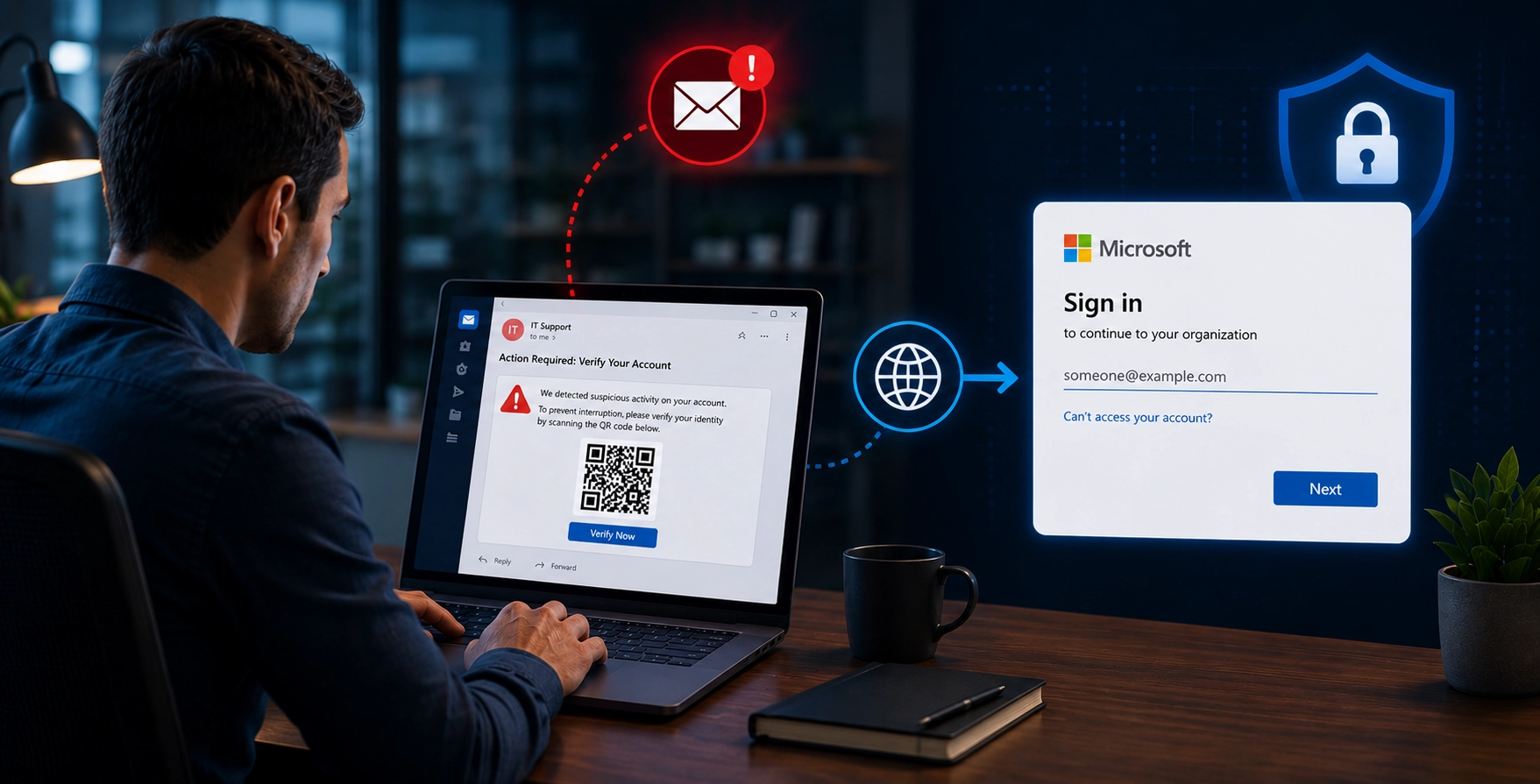
Modern device code phishing usually starts with an email, attachment, or document-themed lure that sends the user to an intermediate landing page rather than directly to Microsoft. Microsoft has observed high-pressure themes such as password expiration, invoices, RFPs, and document access.
The intermediate stage is operationally useful. It lets attackers filter victims, evade scanners, and generate a fresh code only when a real user is engaged.
Phishing email
QR code or landing page
Real Microsoft device login
OAuth token
Issued account takeover
Microsoft’s April 2026 research shows how the technique has matured. Instead of embedding a pre-generated code that expires quickly, the landing page now triggers on-demand device code generation when the victim interacts. Microsoft also observed redirection chains using compromised legitimate domains and cloud platforms such as Vercel, Cloudflare Workers, and AWS Lambda. This solves a major limitation of older attacks: static codes expire quickly, while dynamic generation makes the workflow far more reliable.
Once tokens are obtained, the attack shifts from phishing to cloud-account abuse. Microsoft observed token-backed email exfiltration, malicious inbox rules, and Microsoft Graph reconnaissance to map organizational structure and permissions. MITRE’s guidance on stolen application access tokens and valid cloud accounts explains the risk: attackers can operate as apparently legitimate users while collecting email, abusing cloud services, or preparing business-email-compromise activity.
Social Engineering Analysis
Device code phishing works because it removes several warning signs users have been taught to recognize. The final Microsoft page is often real. The action is not “enter your password into this suspicious form”; it is “enter this code to view a document, confirm a signature, or join a meeting.” That feels procedural and low risk, even though it is the decisive consent event that grants attacker access.
Attackers lean into ordinary business pretexts such as invoices, electronic signatures, voicemails, password-expiration notices, meeting prompts, and document workflows. These are familiar tasks that employees already associate with Microsoft 365 and routine business operations.
This is trusted handoff engineering. The attacker only has to win enough trust to move the victim from the initial lure to the real Microsoft page. From there, Microsoft’s own branding helps legitimize the action. The scam succeeds not because the final destination looks fake, but because the surrounding workflow makes a risky action feel routine.
That matters for awareness strategy. Traditional phishing education emphasizes domain mismatches, spelling mistakes, and unexpected credential prompts. Device code phishing requires a more mature lesson: even on a legitimate sign-in page, users should stop if they did not initiate the session or if the code came through an unsolicited business process.
The key training message is simple:
“Legitimate page” does not always mean “legitimate request.”
Real World Examples
The first major recent example is Storm-2372, which Microsoft says has been active since August 2024. Microsoft reported lures resembling WhatsApp, Signal, and Microsoft Teams experiences, with targets across government, NGOs, IT services, defense, telecommunications, health, higher education, and energy sectors. In this case, device code phishing was used to capture tokens and steal authenticated sessions rather than harvest passwords directly.
Another example is Microsoft’s April 2026 AI-enabled device code phishing campaign. Microsoft described a widespread campaign using backend automation, hyper-personalized role-based lures, and dynamic code generation triggered by victim clicks. Attackers used automation platforms such as Railway to spin up short-lived nodes, created role-aligned lures around invoices, RFPs, and manufacturing workflows, and then focused post-compromise activity on high-value finance and executive targets. This shows device code phishing evolving from a targeted technique into a scalable identity-compromise workflow.
Also in recent news is the FBI’s warning on Kali365. IC3 stated that Kali365 was first seen in April 2026 and distributed mainly through Telegram. The service enabled threat actors to obtain Microsoft 365 access tokens and bypass MFA without intercepting user credentials. The FBI also noted that Kali365 lowers the barrier to entry through AI-generated lures, automated templates, tracking dashboards, and token-capture capability. That advisory is one of the clearest signs that device code phishing is no longer a boutique technique; it is an operationalized criminal service.
MITRE ATT&CK Mapping
The table below maps observed behaviors from Microsoft and the FBI to the closest ATT&CK techniques:
ATT&CK technique
Why it fits device code phishing
T1566.002 Spearphishing Link
The attack is usually delivered through links inside emails, PDFs, QR codes, or business-themed landing pages that push the victim into the authorization flow
T1528 Steal Application Access Token
The central objective is to capture OAuth access and refresh tokens rather than traditional credentials
T1078.004 Valid Accounts: Cloud Accounts
After the victim authorizes the session, the attacker operates through valid Microsoft 365 cloud identity context
T1114.002 Remote Email Collection
Post-compromise activity often includes access to Exchange or Microsoft 365 email using valid credentials or tokens
T1564.008 Email Hiding Rules
Microsoft observed malicious inbox-rule activity to redirect or conceal communications after compromise
ATT&CK notes that spearphishing links can target device-based authorization flows, stolen OAuth tokens can provide ongoing resource access, cloud accounts can be abused as valid identities, and email rules can hide or suppress messages in compromised accounts.
Mitigation Recommendations
Device code phishing changes what “realistic simulation” should mean. A strong simulation should not simply mimic a typo-squatted Microsoft login page. It should recreate the business pretext and handoff sequence that makes entering a code on a legitimate page feel normal.
PhishingBox’s Template Editor can build the email, landing page, and training page together, while the Phishing Simulator can launch campaigns by department or role, measure interaction points, and connect risky actions to follow-up training.
A useful first scenario would model common finance and HR lures: invoice reviews, payroll notices, document-signature requests, password-expiration warnings, and “action required” workflow emails. The simulation could lead to a safe landing page displaying a simulated code and a “Continue to Microsoft” button, followed by a training page explaining why unsolicited device-code entry is dangerous even when the Microsoft page itself is real.
PhishingBox’s editor and simulator support this kind of sequence through editable emails, landing pages, training pages, and AI-assisted localization for different departments and regions.
Another scenario could focus on executive and operations workflows. Microsoft observed attackers enriching target lists and concentrating follow-on activity on higher-value roles, including finance and executive targets. Appropriate lures might include meeting invitations, voicemail notices, urgent RFP access, vendor-payment reviews, or compliance document requests.
The goal is to train users to question the initiation context: Who started this device sign-in, and why? PhishingBox’s role-based targeting and behavior tracking make this kind of department-specific simulation practical.
Organizations should also connect live reporting to current simulation content. KillPhish gives users a fast way to report suspicious emails in Microsoft 365 and Google environments, while Security Inbox lets analysts centralize reported messages, investigate context, and turn confirmed phishes into safe training material through attack replication.
For device code phishing, this is especially valuable. When a real code-entry lure, document-themed phish, or authorization-flow attack appears, the security team can sanitize it and quickly turn it into a simulation that mirrors what employees are already seeing.
Finally, frame the program around Human Risk Management, not just campaign completion. Device code phishing tends to cluster around specific workflows and roles, making it well suited to risk-based coaching. PhishingBox’s Human Risk Management model ties simulation outcomes, training, and reporting behavior into dynamic user and group scores. This helps organizations determine whether finance, HR, or executive populations are improving, or whether they continue to normalize risky authorization behaviors.
That is stronger than simply saying, “We sent another phishing test.” It shows whether the organization is becoming harder to socially engineer in real business contexts.
Measurable KPIs
Organizations should track metrics such as:
Report rate on device-code-themed emails
Attachment interaction rate
Landing-page continuation rate
Simulated code-entry rate
Time-to-report through KillPhish
Repeat-failure rate among targeted departments
Net Reporter Score for suspicious email reporting consistency
60- and 90-day Human Risk Score changes for roles most exposed to this attack pattern
Those measures map cleanly to PhishingBox’s campaign analytics, reporting dashboards, Net Reporter Score, and Human Risk Management workflows.
Conclusion
Device code phishing represents a real shift in modern social engineering. The final login page may be legitimate. The code may only be a few characters. The victim may never hand over a password. But the outcome can still be account takeover, token theft, mailbox access, and business-email-compromise activity.
That combination makes device code phishing both technically novel and deeply human: exactly the kind of threat PhishingBox is well positioned to explain, simulate, and help organizations defend against over time.