
AI-Powered Phishing Becomes “Nation-State Level” at Scale
AI is transforming phishing into highly sophisticated, multi-step attacks at scale. Learn why human behavior is now the primary cybersecurity risk—and...
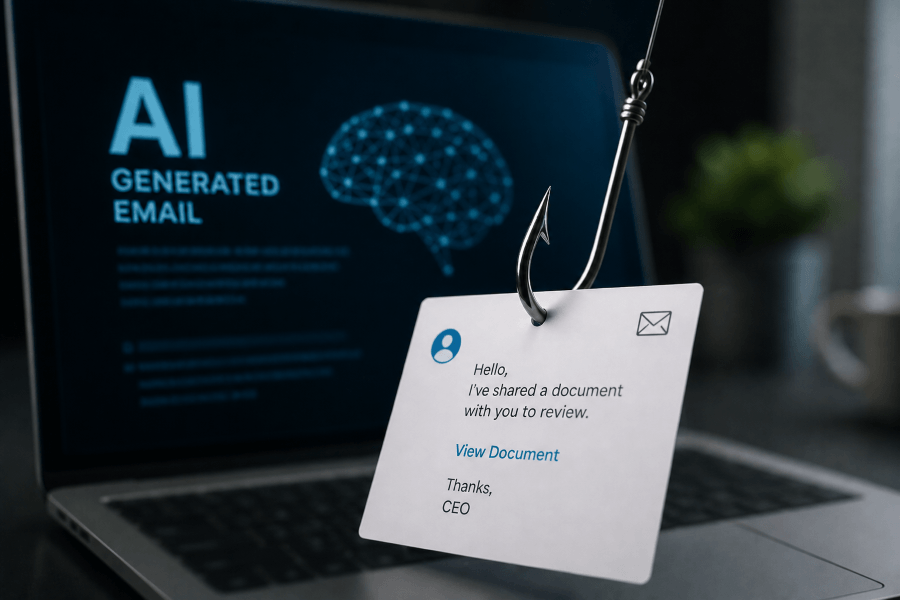
Recent reporting highlights how AI has transformed phishing into a highly sophisticated, multi-stage attack system—accessible even to low-skilled attackers. This represents a major evolution:
- Phishing emails now use legitimate infrastructure (cloud services, CAPTCHAs, redirects)
- AI enables personalized, multi-step attack chains
- Campaigns adapt dynamically to bypass defenses
The key shift: Attackers are engineering full deception workflows. This dramatically increases success rates because:
- Messages look legitimate
- Attack paths feel natural
- Users don’t encounter obvious red flags
AI Lowers the Barrier for “Script Kiddie” Attacks
AI tools are enabling inexperienced attackers to identify vulnerabilities and launch advanced attacks previously limited to elite actors. While this appears technical, the real amplification is social:
- More attackers → more phishing campaigns
- Faster vulnerability discovery → quicker exploitation via social engineering
- Increased volume of credential theft and impersonation attacks
Additionally:
- AI compresses the timeline between discovery → exploitation
- Social engineering becomes the fastest path to capitalize on new vulnerabilities
AI Threat Models Raise Concerns for Critical Infrastructure
Advanced AI systems capable of discovering and exploiting vulnerabilities are raising alarms among governments and infrastructure operators. Even highly technical threats still rely on human exploitation:
- AI finds vulnerabilities → attackers still need initial access
- Social engineering remains the most reliable entry point
- Critical infrastructure employees become prime targets
This reinforces a consistent pattern: No matter how advanced the exploit, humans are still the gateway.
Cross-Threat Patterns This Week
Across all incidents, four consistent trends emerge:
1. AI is Scaling Social Engineering
- Faster, cheaper, more personalized attacks
- Removes skill barrier for attackers
2. Identity is the Primary Target
- Credentials, MFA, and access tokens
- Less focus on malware, more on access
3. Multi-Step Deception is the New Norm
- Email → website → interaction → compromise
- Blends into legitimate workflows
4. Human Behavior is Still the Weakest Link
- Technical defenses are bypassed via user actions
- Awareness alone is insufficient without behavior change
Strategic Takeaway
Cybersecurity risk is increasingly a human problem, not a technical one.
Organizations that rely solely on:
- Email filtering
- Endpoint protection
- Network controls
…will continue to be bypassed by social engineering-first attacks.
Why PhishingBox is Directly Aligned to This Threat Landscape
PhishingBox addresses the root cause of these attacks:
1. Simulates Real Attacks (Not Theoretical Ones)
- AI-generated phishing
- Vishing and impersonation
- Multi-stage attack chains
2. Changes User Behavior
- Reinforcement through repetition
- Immediate feedback loops
- Contextual training tied to real actions
3. Measures Human Risk
- Quantifiable improvement over time
- Identifies high-risk individuals and roles
- Enables data-driven security decisions
4. Adapts to Emerging Threats
- Keeps pace with AI-driven attack evolution
- Expands beyond email into multi-channel threats